The sound that shattered my mornings was never subtle, never accidental, and never apologetic. It wasn’t birdsong, lawn sprinklers, or the gentle hum of neighborhood life. It was the violent scream of a high-performance engine tearing through Maple Creek Estates like a declaration of superiority, as if the driver were announcing to the entire community that rules did not apply to him. Every time I heard it, my shoulders tightened before I even saw the car, because I already knew what was coming. The metallic-green Lamborghini would surge down the street, drift too close to the curb, hesitate for half a second, and then cut straight across my lawn like it was nothing more than an extension of the asphalt. The grass would tear, the soil would split, and years of careful maintenance would be reduced to muddy scars in a matter of seconds. From my porch, holding my coffee, I watched it happen over and over again, feeling less like a homeowner and more like an unwilling spectator to someone else’s recklessness. What made it worse wasn’t just the damage itself, but the way it happened so casually, without hesitation or remorse, as though my property and my memories were disposable. That lawn wasn’t just grass. It was something my late wife and I had built together, inch by inch, during the last healthy years we shared. We had argued over fertilizer, laughed over crooked edging, and celebrated every spring when it came back stronger. Watching it destroyed repeatedly felt like watching someone erase pieces of our life together, one tire track at a time.
Everyone in the neighborhood knew who was responsible. Julian Crowe made no effort to hide it. He was young, wealthy, and untouchable, or at least he believed he was. As the son of Leonard Crowe, the long-standing president of the HOA, he moved through the community with a confidence that bordered on arrogance. Rules were for other people. Speed limits were suggestions. Property lines were inconveniences. I had tried, at first, to handle things the reasonable way. I knocked on doors, made polite complaints, and filed formal reports. Each time, the response was the same: vague promises, empty apologies, and nothing changing. Eventually, I went directly to Leonard. I found him one afternoon meticulously washing his SUV, as if polishing authority itself. When I told him about the damage, he listened with practiced patience and responded with rehearsed condescension. He excused his son’s behavior as youthful energy, framed recklessness as learning, and subtly reminded me that HOA inspections were approaching. The message was clear without being spoken: complain too much, and I would be the one punished. His son could destroy my lawn repeatedly, but I would be fined if I didn’t keep it pristine. That conversation changed something in me. I realized I wasn’t dealing with ignorance or misunderstanding. I was dealing with entitlement backed by institutional power. They weren’t going to stop because it was wrong. They were going to stop only if it became inconvenient.
That night, instead of lying awake replaying the injustice in my head, I did something different. I pulled out the HOA bylaws and read them from beginning to end. I didn’t skim. I didn’t look for shortcuts. I studied every clause, every footnote, every buried provision that most homeowners never bothered to read. For hours, I sat at my kitchen table, surrounded by papers, highlighting sections and making notes. I wasn’t searching for revenge. I was searching for permission. Eventually, I found it tucked away in a section about drainage and erosion control. It allowed homeowners to install subsurface reinforcement systems to prevent runoff and soil degradation, as long as they didn’t exceed the natural grade of the land and complied with municipal codes. It was meant for flood prevention and landscaping stability, but it gave me exactly what I needed: legal authorization to rebuild my lawn in a way that protected it from repeated damage. The next morning, I filed the necessary paperwork, obtained the permits, and scheduled equipment rental. I didn’t confront Julian. I didn’t warn Leonard. I didn’t make threats. I simply followed the rules more carefully than anyone ever expected me to.
Over the next two days, I transformed my yard with quiet precision. I rented a compact excavator and dug a trench exactly where Julian’s tires always landed, following the same arc his car had carved into my grass for months. It was deep, deliberate, and invisible from the street. I installed steel reinforcement rods at the base, placed according to engineering guidelines, and filled the cavity with loose decorative stone designed for drainage and collapse prevention. On top of that, I laid fresh sod, watered it thoroughly, and trimmed it to match the rest of the lawn. From the outside, it looked perfect. Healthier than before. Smoother. More inviting. Neighbors asked what I was doing, and I answered honestly, explaining that I was installing erosion control to deal with ongoing damage from unauthorized vehicles. Everything was documented. Every receipt was saved. Every inspection was completed. Every step was compliant. When I finished, I stood back and looked at it, not with satisfaction, but with quiet certainty. I wasn’t setting a trap. I was reinforcing my property within the law. If someone chose to drive over it again, that choice would be theirs alone.
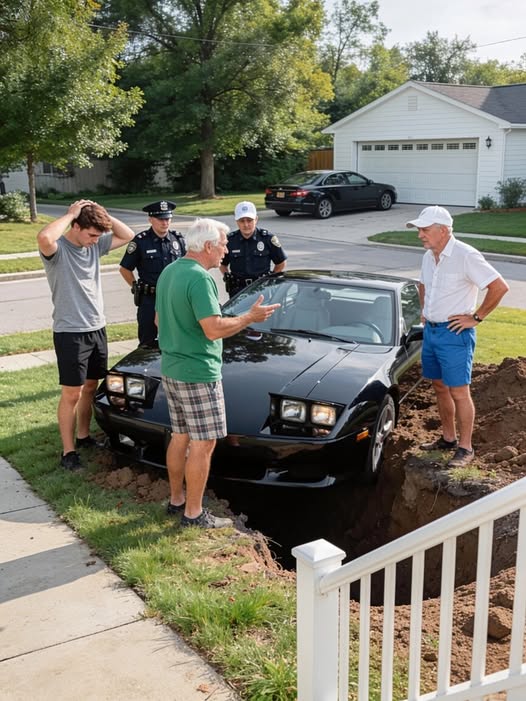
The morning it happened was almost peaceful. The air was cool, the sky clear, and the street unusually quiet. I sat on my porch, coffee in hand, listening. When I finally heard the engine, it was louder than usual, more aggressive, as if Julian were showing off. The Lamborghini approached at speed, drifted toward the curb, and cut across my lawn without slowing. This time, the ground didn’t yield politely. It gave way completely. The front end dropped into the reinforced cavity with a sharp, final crash, metal and carbon fiber meeting gravity in a way no amount of money could undo. The car stopped instantly, half-swallowed, twisted at an unnatural angle. Julian stumbled out, shouting in disbelief, staring at his ruined vehicle like a child who had finally discovered limits. Leonard arrived moments later, furious, accusing me of sabotage and manipulation. I calmly handed over my permits to the responding officers. They reviewed the documents, inspected the site, and followed the tire tracks straight from the road into the collapse zone. Their conclusion was simple: Julian had left the roadway and entered a permitted construction area at speed. The fault was his. Insurance denied coverage. The HOA board launched an internal review. Leonard resigned within weeks. Without his influence, other complaints surfaced. Julian lost his license. The consequences unfolded quietly, without drama, exactly as rules intended.
Today, my lawn is stronger than it has ever been. The soil is stable, the grass thick, and the edges clean. No one drives over it anymore. In the evenings, I sometimes stand there and watch the sunlight settle across the yard Rebecca and I once built together. I think about how power often survives not because it is right, but because people assume it is unchangeable. I think about how quietly reading the fine print can be more effective than shouting. I didn’t win by being louder, richer, or more connected. I won by understanding the system better than the people who thought it belonged to them. That experience taught me something I carry with me now: dignity doesn’t always require confrontation. Sometimes, it requires patience, preparation, and the courage to let others face the natural results of their own behavior. My lawn stands as proof of that lesson, rooted in resilience, protected by knowledge, and finally free from entitlement. And in the quiet that has returned to my mornings, I hear something better than any engine ever sounded. I hear peace.